 跳到内容
跳到内容 
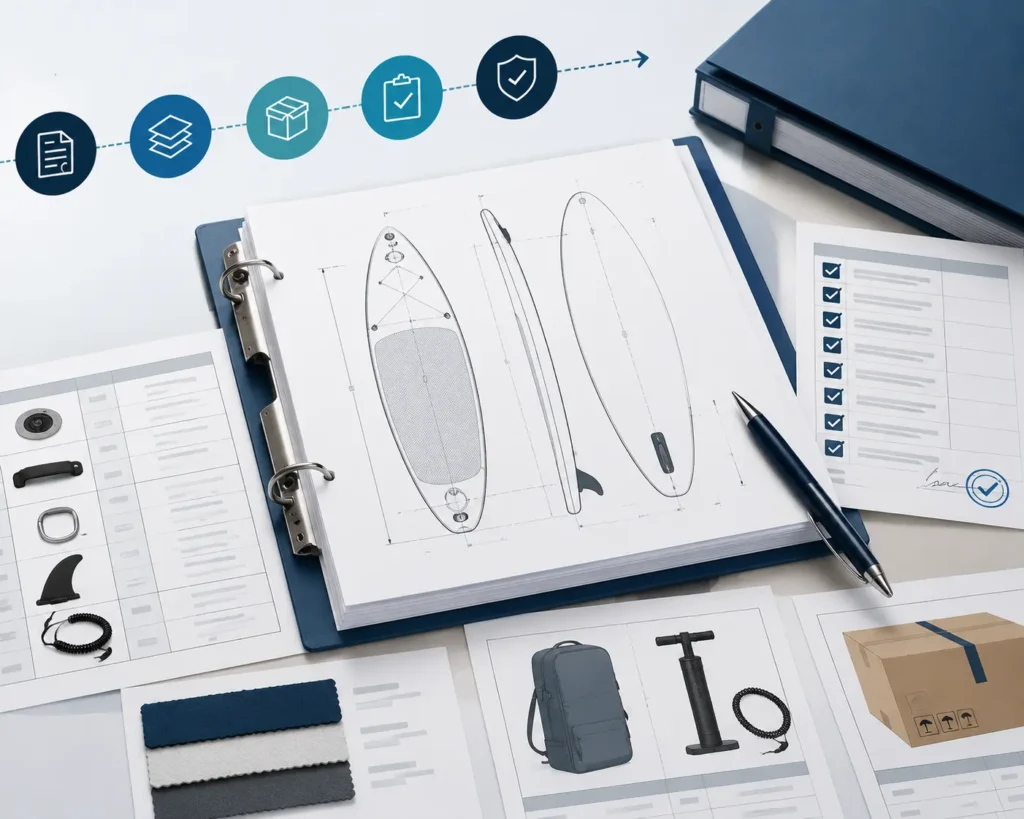
An inflatable SUP tech pack should identify the exact product revision and define the board, materials, components, artwork, accessories, packaging, inspection requirements, and approval status in enough detail for sampling and production teams to work from the same source. It should also show who approved each controlled file and how later changes are recorded.
This guide is for product managers and technical sourcing teams after the commercial concept has been defined. It is not the initial business brief used to explain the target market, budget, estimated order quantity, or launch date. It is the technical control file that converts an agreed product direction into reproducible instructions.
Start With the Purpose of the Tech Pack
A tech pack should answer three questions:
- What exactly is the supplier expected to make?
- Which document or sample controls each requirement?
- How will the buyer and supplier recognize an approved change?
A collection of emails, marked-up photos, and artwork attachments does not answer these questions reliably. Important details may be split across different conversations, and two teams may use different versions without realizing it.
The solution is not necessarily one large document. A tech pack can be a controlled set of drawings, specifications, artwork files, component schedules, packaging files, and approval records. What matters is that the files use a common product code, revision system, and document index.
Use a Document Index as the Control Page
The first page should identify the product and list every file that forms the approved tech pack.
Include:
- Brand, product name, and product or project code
- Tech pack revision and issue date
- Document owner and authorized approvers
- Current drawing, specification, artwork, component, accessory, and packaging file names
- Approval status of each file
- Open items that prevent sampling or production
- Revision history showing what changed, when, and who approved it
Do not label a file “final” without a revision identifier. Names such as final, final-new, and final-2 make it difficult to prove which instruction is current.
Define the Finished Board
The product specification should describe the finished SUP rather than relying on a model name or reference photograph.
Record the requirements relevant to the approved design:
- Finished length, width, thickness, outline, and other controlled dimensions
- Nose, tail, rocker, and deck-profile references where applicable
- Construction description and reinforcement locations
- Valve, fin system, handles, D-rings, bungee, deck pad, and fitting layout
- Artwork zones and component positions
- Finished weight or other measurable characteristics only when the project has an approved requirement and method
Use dimensioned drawings where position and scale matter. A photo can show intent, but it cannot reliably control measurements.
The buyer does not need to prescribe every internal factory method. The tech pack should control the product characteristics and evidence needed for approval. Process instructions that belong to the manufacturer can remain in the manufacturer’s controlled production system unless the buyer has a justified project-specific requirement.
Specify Materials Without Relying on Marketing Names
Material descriptions should be specific enough to prevent an unapproved substitution, while respecting legitimate supplier-confidential information.
A useful material reference may include:
- Buyer or supplier material code
- Construction or material description
- Color reference
- Approved supplier or equivalent rule, where applicable
- Location of use
- Required supporting record or sample
- Substitution approval requirement
Terms such as “premium PVC,” “fusion,” or “military grade” are not complete material specifications by themselves. If a proprietary source or formulation cannot be disclosed, define the required product characteristics and the evidence the buyer will use to evaluate an alternative.
ALS presents material, color, 3D-modeling, graphic, packaging, and sampling options in its custom design and brand incubation service. The project tech pack still needs to record the exact option approved for the specific SUP.
Build a Controlled Component and Fitting Schedule
The tech pack should identify every component that affects function, appearance, compatibility, or pack-out.
For each item, record:
- Component name and code
- Quantity per board
- Material, size, color, or model reference as needed
- Board location or drawing reference
- Branding requirement
- Approved alternative, if one exists
The schedule may cover the valve, fin box and fin, handles, D-rings, bungee fittings, deck pad, leash point, and other model-specific parts.
Do not write “standard valve” or “normal fin” when compatibility matters. If the buyer accepts several options, list them as approved alternatives rather than leaving the choice undefined.
Separate Artwork Files From Artwork Instructions
The original artwork file is only one part of production control. The tech pack should also specify how it is used.
Record:
- Released file name and revision
- Print or application method
- Scale and placement dimensions
- Orientation and approved artwork zone
- Color references
- Relationship to seams, fittings, deck pad, or other features
- Required proof or sample approval
Review artwork at the intended production scale. A visually correct PDF on a screen does not prove that the logo dimensions, placement, or orientation are correct on the board.
Define the Accessory and Packaging Configuration
The sellable product includes more than the board. Create one controlled pack-out list covering:
- Paddle, pump, leash, fin, bag, repair materials, and other included accessories
- Accessory model, quantity, color, and branding
- Manual, warning, and label files
- Barcode and carton-mark requirements
- Retail packaging and shipping-carton references
- Placement and packing sequence where mix-ups are possible
Link every printed item to a released file revision. Destination-market warnings, claims, instructions, and compliance wording should be reviewed by qualified resources for the intended market; the tech pack controls the approved text but does not establish that the text is legally sufficient.
The ALS inflatable SUP range can help buyers identify model and component starting points. The final project file must still state which board, fittings, accessories, and packaging are approved for the order.
Add Project-Specific Tolerances and Acceptance Requirements
A specification is incomplete when it lists a nominal target but gives no basis for accepting normal variation.
For each characteristic that needs control, identify:
- Requirement or nominal value
- Permitted tolerance or acceptance boundary
- Inspection or test method
- Condition under which the check is performed
- Sample or unit identification
- Required record
- Responsibility for review and disposition
Do not copy generic tolerances, pressures, test durations, or acceptance limits from another model. These must be confirmed for the actual product, construction, and intended use.
The tech pack should reference the applicable inspection or test requirement rather than trying to turn the entire document into a quality manual. Detailed sampling plans, test procedures, and inspection forms may remain separate controlled documents.
Link the Tech Pack to Samples Without Letting the Sample Replace It
An approved sample is useful for appearance, workmanship, proportions, and the assembled product experience. It cannot fully reveal internal construction, material identity, tolerances, test conditions, or the current packaging file.
The tech pack should therefore record:
- Reference-sample identity
- Sample approval status
- Related tech pack revision
- Known deviations that must not be copied
- Features controlled by documents rather than the physical sample
If the sample conflicts with the written specification, the buyer and supplier must resolve which reference controls. Do not allow production teams to choose the more convenient version.
Control Revisions and Approvals
Every change should create a traceable decision.
A revision record should state:
- Requested change
- Reason for the change
- Affected files, components, artwork, or packaging
- Need for a new sample, check, or approval
- Commercial or schedule impact where applicable
- Approver and approval date
- Date the old revision becomes obsolete
After approval, update the document index and withdraw the superseded file from active use. Email approval can support the record, but the approved change should also appear in the controlled tech pack.
Apply a Simple Completeness Test
Before releasing the tech pack for sampling or production, ask a person who was not involved in the earlier discussions to review it.
The file is not ready if that reviewer must guess:
- Which product or revision is being made
- Which attachment is current
- Which component or accessory is included
- Where artwork is positioned
- Which packaging version applies
- What variation is acceptable
- Who can approve a deviation
Record missing information as open items with an owner and due date. A tech pack may support early sampling while some items remain open, but those open items must be visible and must not be mistaken for production approval.
Inflatable SUP Tech Pack Checklist
- Controlled product and revision identity
- Document index and approval status
- Dimensioned board drawing
- Construction and material references
- Component and fitting schedule
- Released artwork and placement instructions
- Accessory and spare-part configuration
- Retail packaging, labels, manuals, and carton files
- Project-specific tolerances and acceptance references
- Inspection and test document references
- Approved sample identity and known deviations
- Revision history, approvers, and obsolete-file control
- Open-item list with owners and release consequences
Frequently Asked Questions
Is a tech pack the same as a product brief?
No. A product brief explains the commercial and product direction, such as intended application and desired features. A tech pack converts the approved direction into controlled technical instructions for sampling and production.
Does a private label SUP need a tech pack?
Yes, but it may be shorter. It should still identify the base model, approved graphics, colors, components, accessories, packaging, labels, and any permitted changes. Using an existing platform does not remove the need for version control.
Should the buyer or the manufacturer own the tech pack?
Ownership and access should be agreed commercially and, where necessary, legally. Operationally, both parties need access to the same approved revision. The buyer should retain the files and approvals necessary to define and manage its product without transferring information it does not have the right to use.
Request a Tech Pack Completeness Review
Before approving a sample or releasing production, place the drawing, material references, component schedule, artwork, accessories, packaging, acceptance requirements, and revision index into one controlled file set.
ALS can review that file set against the proposed SUP configuration and identify missing, conflicting, or unapproved information before it becomes a sampling or production error.
