 跳到内容
跳到内容 
Inflatable kayak quality control should begin before a sample is built, not when finished cartons reach the warehouse. A buyer needs one approved specification, a defined inspection plan, traceable production records, and clear release criteria. ISO 6185 can help frame safety requirements, but the correct part and applicable obligations depend on the craft type, propulsion, dimensions, intended market, and current regulatory context.
This guide turns those requirements into a practical B2B checklist for brands, distributors, rental operators, and purchasing teams. It does not replace the purchased standard, laboratory review, or legal advice. Instead, it shows what evidence to request from an inflatable kayak manufacturer before approving a sample or releasing a production batch.
1. Confirm Which ISO 6185 Scope Applies
Do not write “ISO 6185 compliant” as a generic checkbox. The official ISO 6185-1 listing explains the scope of Part 1, while the wider series separates inflatable craft by characteristics such as propulsion, motor power, size, and craft type. Inflatable canoes and kayaks are identified within the Part 1 framework, while other powered inflatable boats can fall under different parts. Start by documenting the exact product configuration and asking a qualified laboratory or compliance specialist to confirm the applicable edition and market requirements.
- Intended use: recreation, touring, rental, fishing, whitewater, or another defined application
- Propulsion: manual, sail, or motor-ready
- Overall dimensions, chamber arrangement, and stated capacity
- Maximum persons, payload, and any motor rating
- Target sales countries and required marking or documentation
- Product family differences that may require separate assessment

2. Freeze the Approved Kayak Specification
Quality cannot be inspected against a quotation alone. Create a controlled specification that identifies the approved drawing revision, dimensions, materials, working pressures, chamber layout, fittings, accessories, artwork, labels, packaging, and test requirements. The golden sample should be linked to the same revision. If the buyer changes a seat, valve, fin box, floor, handle, or printed warning after approval, record the change and decide whether retesting is necessary.
Use the field list in the inflatable kayak RFQ guide to make quotations comparable before sampling. Buyers comparing reinforced PVC side tubes with full drop-stitch construction should also review the PVC vs drop-stitch kayak guide.
3. Verify Materials by Lot, Not by Appearance
A visually acceptable fabric roll may still be the wrong construction, coating, color, or supplier lot. The incoming-quality record should connect each major material to a purchase lot and the production batch that used it. Review supplier declarations and test reports for the properties required by the approved specification. Do not copy a universal thickness, denier, tensile value, or chemical limit into every product; set values according to the design, use case, applicable standard, and target market.
- Reinforced coated fabric and drop-stitch material identification
- Coating, base cloth, color, finish, and approved supplier
- Valve, D-ring, handle, fin box, drain, seat, and footrest materials
- Adhesive or welding-process compatibility where relevant
- Material test-report number and lot traceability
- Storage conditions and shelf-life control for time-sensitive materials

4. Control Cutting, Welding, Bonding, and Assembly
The inflatable kayak quality control plan should identify critical process parameters and who is authorized to approve them. Check panel identity and orientation before assembly. For welded seams, record the validated machine setup, tooling, operator, and first-piece approval. For bonded components, control surface preparation, adhesive batch, mix or activation method, open time, cure time, and environmental conditions when these affect performance.
Do not accept “operator experience” as the only evidence. Ask for a dated first-piece record and an in-process inspection sheet. If production is moved to another line, machine, facility, or subcontractor, require written approval before the change.
5. Inspect Chamber Layout and Seam Continuity
Compare the finished kayak with the approved chamber diagram. Confirm that chambers are independently inflatable as designed, valves are assigned correctly, internal partitions are not twisted, and seams follow the intended path without folds, contamination, skipped areas, or heat damage. A cosmetic inspection should never replace structural and air-retention checks.
6. Check Valves, Drains, Fittings, and Attachments
Small components generate disproportionate field complaints because they are handled repeatedly and can create leak paths. Confirm valve type, cap, gasket, core position, installation torque or assembly method, and access for service. Test drains in both open and closed conditions. Pull, load, or function-check handles, D-rings, seat anchors, footrests, paddle holders, fin boxes, towing points, and bungee anchors according to the approved plan.
7. Run a Controlled Air-Retention Test
Define the test pressure, stabilization period, hold time, measurement method, ambient conditions, and acceptance limit in the product specification. Record each chamber separately. Temperature changes can affect pressure readings, so a buyer should not compare two readings without considering the test environment. Where a leak is suspected, locate and document it rather than simply reinflating the unit.
The record should identify the product serial or batch number, gauge ID and calibration status, start and finish readings, inspector, result, repair history, and final disposition. A repaired unit needs a defined retest, not an automatic pass.
8. Verify Dimensions, Pressure Labels, and Workmanship
Measure the kayak after it has stabilized at the specified working pressure and conditioning state. Compare length, width, floor position, symmetry, rocker, valve placement, seat position, fin alignment, and other controlled dimensions with the approved tolerance table. Check for twist, wrinkles at critical seams, exposed adhesive, abrasion, sharp edges, printing defects, contamination, and mismatched colors.
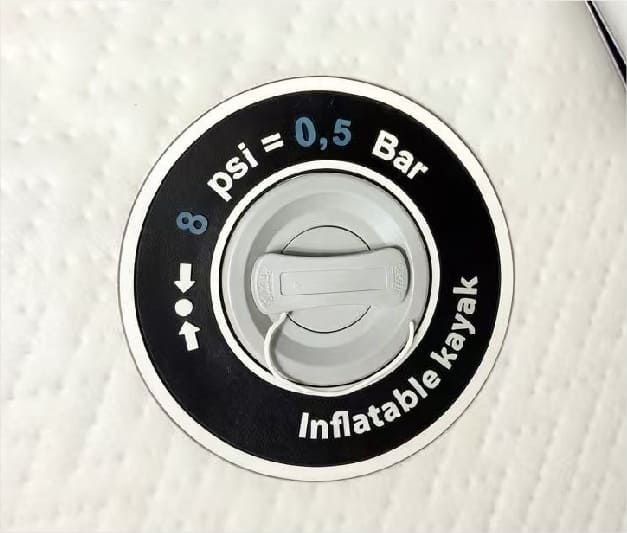
Pressure labels and inflation instructions must match the chamber design and supplied pump or gauge. Conflicting labels, manuals, and packaging create misuse risk even when the kayak itself is correctly built.
9. Validate Capacity, Stability, and Functional Performance
Design validation and routine production inspection are different. Type or compliance testing may address capacity, buoyancy, stability, flotation, structure, fittings, and other safety characteristics for the applicable craft. Routine batch control should confirm that production continues to match the validated design. Agree which tests are performed by an accredited or qualified third party, which are factory validation tests, and which are repeated during production.
- Specified capacity and loading information
- Seating, footrest, paddle, fin, drain, and carry functions
- Tracking and handling checks under the approved test plan
- Deflated-chamber or flotation conditions where applicable
- Recovery, drainage, and reboarding-related features where specified
- Consistency between test sample, production unit, labels, and manual
10. Approve Labels, Manual, and Traceability
A kayak can fail a market review because the physical product, label, declaration, and manual describe different configurations. Build a documentation matrix covering product identity, model, responsible economic operator where required, capacity information, working pressure, warnings, serial or batch traceability, assembly instructions, maintenance, repair, storage, and supplied accessories.
Certificates and reports should identify the tested model and revision. A company-level management-system certificate is not a substitute for product-specific evidence. For a broader supplier and process review, use the inflatable product factory audit checklist.
11. Control Accessories and Packaging
Compare every carton with the approved bill of materials and pack-out sample. Verify seats, paddles, fins, pump, gauge, hose, repair materials, bag, straps, instructions, labels, spare parts, and retail inserts. Check that accessories fit the exact kayak configuration. Use barcode and carton-marking verification to prevent correct products from entering incorrect packaging.

12. Release the Batch with Evidence
A final inflatable kayak quality control report should connect the purchase order, specification revision, material lots, production dates, sample size, test equipment, results, defects, rework, and release decision. Define defect classes and sampling rules before inspection. Critical safety or specification failures should have clear escalation rules; they should not be averaged away by a favorable cosmetic score.
| Quality gate | Evidence to request | Buyer decision |
|---|---|---|
| Design approval | Controlled drawing, specification, bill of materials, golden sample | Approve configuration and revision |
| Compliance plan | Applicable-standard review, test plan, model coverage | Confirm scope with qualified specialist |
| Incoming materials | Lot records, supplier documents, required test results | Release or hold material |
| Production process | First-piece and in-process records, parameter checks | Continue, correct, or stop production |
| Finished product | Air retention, dimensions, functions, workmanship | Pass, rework, retest, or reject |
| Shipment release | Final inspection, pack-out, traceability, release signature | Authorize shipment |
Inflatable Kayak Quality Control Checklist
- Define the craft, intended use, target market, and applicable ISO 6185 scope.
- Freeze the drawing, bill of materials, working pressures, labels, and packaging revision.
- Link the golden sample to the same controlled specification.
- Verify critical materials and components by approved supplier and lot.
- Approve cutting, welding, bonding, and assembly process controls.
- Inspect chamber independence, seam continuity, and internal alignment.
- Check valves, drains, handles, D-rings, seats, footrests, fins, and towing points.
- Run documented air-retention tests under controlled conditions.
- Verify dimensions, symmetry, workmanship, and label consistency.
- Complete applicable validation and functional testing.
- Match every accessory and document to the approved pack-out.
- Release only with a traceable final inspection and disposition record.
Frequently Asked Questions
Does ISO 6185 certification cover every inflatable kayak model?
No. Buyers should confirm the applicable part, edition, product type, model coverage, and target-market obligations. A report for one construction or configuration should not automatically be treated as evidence for every size, chamber layout, material, or accessory combination.
Is a final random inspection enough?
No. Final inspection can find visible defects and verify selected functions, but it cannot reconstruct missing material, process, or validation records. Effective inflatable kayak quality control uses design, incoming, in-process, finished-product, and shipment-release gates.
What records should accompany a pre-production sample?
Request the controlled specification, bill of materials, material identification, process and inspection records, air-retention results, dimensional report, accessory list, artwork, labels, manual, packaging approval, and any applicable product-test evidence.
How should buyers handle a production change?
Require a written change request that states what changes, why, which models and orders are affected, what risks were reviewed, and what verification or retesting is required. Do not allow unapproved substitutions after sample approval.
Build the Checklist into the Purchase Order
The best checklist is enforceable. Attach the approved specification, inspection plan, change-control rule, evidence list, and release criteria to the purchase order or quality agreement. If you are comparing suppliers, first use the inflatable kayak supplier vetting guide, then evaluate the physical sample using the sample-approval framework adapted to your kayak requirements.
Preparing a private-label kayak program? Send ALS Leisure your intended use, target market, construction, capacity, accessories, artwork, packaging, and compliance requirements. Our team can review the brief and organize the sample and quality-control records needed for an informed approval.
