 跳到内容
跳到内容 
A PVC vs drop stitch kayak comparison is not simply a question of selecting the “better” construction. The right choice depends on the price tier, sales channel, paddling environment, shipping model, and after-sales risk your product range is designed to serve.
For brands, distributors, rental operators, and private label buyers, the most useful comparison has three parts: standard PVC tube construction, a hybrid kayak with a drop-stitch floor, and a full drop-stitch hull. Each architecture creates different requirements for pressure, valves, seams, accessories, sample testing, packaging, and customer education.
This guide explains how to compare those structures and turn the decision into a practical product specification. Buyers who are still defining the wider assortment can first review our inflatable kayak product range planning guide.
PVC vs Drop Stitch Kayak: The Short Answer
In a PVC vs drop stitch kayak comparison, a standard reinforced-PVC model normally relies on inflated side chambers and a flexible or moderately reinforced floor. It is generally easier to pack, less costly to produce, and suitable for entry-level recreational positioning. A full drop-stitch kayak uses internally connected fabric panels that can form flatter, more rigid sections when inflated to the pressure specified for that design. It is usually positioned in a higher price tier and can provide a firmer platform and more defined hull geometry.
A hybrid design sits between them: conventional side tubes provide buoyancy and familiar stability, while a removable or integrated drop-stitch floor increases stiffness under the paddler. For many product ranges, this middle option is commercially important because it adds a visible performance upgrade without requiring every chamber to use full drop-stitch construction.
| Buyer criterion | Standard reinforced-PVC kayak | Drop-stitch floor hybrid | Full drop-stitch kayak |
|---|---|---|---|
| Typical market position | Entry to value recreational | Mid-range recreational or rental | Performance-oriented or premium |
| Primary structural form | Inflated tubes with flexible floor system | PVC side tubes with rigid drop-stitch floor | Drop-stitch floor and side/hull panels |
| Platform feel | Softer and more forgiving | Firm floor with rounded side chambers | Firm, panel-based structure |
| Packing and setup | Usually simple and compact | Additional floor chamber and pressure step | More high-pressure chambers to manage |
| Best product-line role | Accessible opening price point | Step-up model with clear upgrade story | Flagship model for performance positioning |
1. Define the Construction Before Comparing Quotations
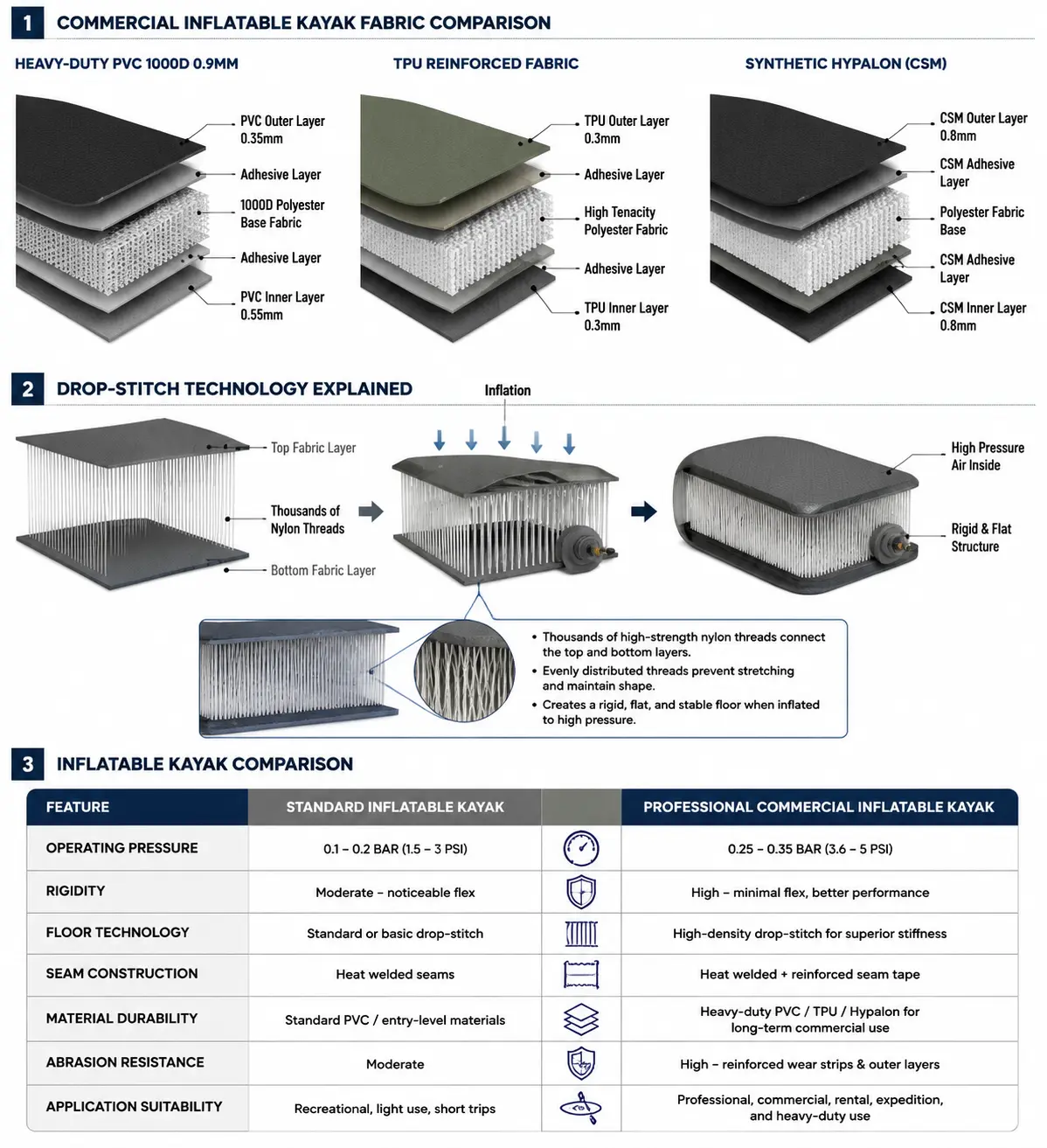
“PVC kayak” and “drop-stitch kayak” are often used as if they describe two different materials. That is misleading. PVC is commonly used as an airtight coating or laminate in both conventional and drop-stitch inflatable products. Drop-stitch describes a structural method: internal yarns connect two fabric surfaces and limit how far they can separate under pressure.
Before comparing prices, ask each supplier to identify the construction of every chamber. A quotation should state whether the floor is an I-beam, inflatable tube, removable drop-stitch insert, integrated drop-stitch panel, or part of a full drop-stitch hull. It should also identify the sidewall construction, chamber count, seam method, reinforcement locations, target working pressure, valve model, and pressure-relief strategy if applicable.
2. Match the Structure to the Intended Customer
The target user should determine the construction tier. A value retail customer who paddles occasionally on sheltered water may prioritize easy setup, compact storage, and an accessible price. A touring customer may place more value on stiffness, tracking, seating position, and a cleaner hull profile. A rental operator may care most about repeat inflation, drying time, replaceable parts, visible wear points, and straightforward staff inspection.
- Entry retail: prioritize understandable setup, complete accessories, carton efficiency, and a realistic performance promise.
- Mid-range outdoor retail: use a drop-stitch floor or stronger hull definition to create a meaningful step-up SKU.
- Rental fleets: evaluate handling, drainability, repair procedures, valve access, and replacement-part consistency over repeated cycles.
- Premium private label: consider full drop-stitch construction when the range needs firmer handling, a technical sales story, and stronger visual differentiation.
A product should not be upgraded to full drop-stitch only because a higher-pressure specification looks attractive. The hull shape, fin system, rocker, width, seat position, and load distribution still determine how the kayak behaves. Construction is one design input, not a substitute for sample testing.
3. Compare Rigidity, Stability, Tracking, and Comfort Separately
Buyers often compress several performance questions into one word: “rigid.” A firmer floor can reduce flex, but that does not automatically answer whether the kayak feels stable, tracks well, turns easily, or remains comfortable during a long session.
Rigidity under load
Measure how the floor and hull behave with the intended paddler load, not only when the empty kayak is displayed in a showroom. Check seat support, floor deflection, chamber pressure after stabilization, and whether the hull remains symmetrical.
Primary stability
Rounded side tubes can create a reassuring recreational platform, while flatter full drop-stitch panels can create a different edge and seating feel. Width, center of gravity, seat height, and hull cross-section must be assessed together.
Tracking and maneuverability
A defined bow, stern profile, rocker, removable fin, and balanced loading may influence tracking as much as the chamber technology. Test the production-intent sample with the supplied seat and fin rather than an upgraded demonstration setup.
Comfort and usable space
Record the usable cockpit length and width after inflation. Thick side tubes may reduce interior space; a slimmer panel structure may increase it, but seat anchoring and foot support must still work for the target user group.
4. Treat Pressure as a Controlled Specification
Do not copy a pressure number from a competitor or request the highest value a factory can print. The approved working pressure must be supported by the material construction, seam design, valve, panel geometry, operating instructions, and factory test method.
Ask the supplier to document the working pressure for each chamber, inflation sequence, gauge tolerance, overpressure warnings, and test conditions. A hybrid kayak may require different pressures for the side tubes and drop-stitch floor. The manual, valve labels, pump gauge, carton instructions, and online product page must all agree.
During sampling, observe inflation time, valve access, gauge readability, chamber interaction, and pressure retention after the product reaches a stable temperature. Do not treat one short showroom inflation as proof of production consistency.
5. Evaluate Seams, Reinforcements, and Wear Points
The most important quality difference may be process execution rather than the construction label. Review how the supplier controls panel cutting, welding or bonding parameters, seam overlap, reinforcement patches, valve installation, D-rings, handles, fin boxes, drain fittings, and transitions between different materials.

Map expected wear points for the target application. Rental and frequent-use products may need extra protection at the bow, stern, keel, carry handles, seat anchors, and underside contact zones. Any reinforcement should be included in the approved specification and weight record; it should not be added informally after sampling.
6. Calculate the Commercial Cost, Not Only the Unit Price
Full drop-stitch construction can change more than the factory price. Compare the complete commercial model:
- material and conversion cost;
- number and type of valves;
- pump specification and gauge requirement;
- inflation time and customer setup complexity;
- packed dimensions and gross weight;
- carton protection and shipping efficiency;
- repair kit and replacement-part requirements;
- inspection time and pressure-test capacity;
- likely customer questions, misuse risks, and warranty handling.
A standard PVC model may produce a lower landed cost and wider entry-level demand. A full drop-stitch model may support a higher retail position, but only if the handling, finish, accessories, instructions, and product story justify the difference. A hybrid can be an effective bridge SKU when the range needs a clear good-better-best structure.
7. Use a Three-Sample Product-Line Decision
If your range may include more than one construction, compare representative samples under the same test plan rather than evaluating each product separately. Use the same target load, paddling route, setup team, inflation gauge, observation form, and scoring scale.
| Test area | What to record | Why it matters to buyers |
|---|---|---|
| Unpacking and setup | Parts count, instructions, inflation sequence, setup time | Customer experience and support load |
| Static load | Floor deflection, symmetry, seat position, freeboard | Fit for intended user and load claim |
| On-water handling | Tracking, turning, wind response, paddle clearance | Channel positioning and review risk |
| Landing and handling | Carry balance, abrasion zones, fin protection | Rental and frequent-use practicality |
| Deflation and drying | Drainage, trapped water, folding sequence, repacking time | Storage, returns, and mildew-prevention instructions |
| Post-test inspection | Pressure change, seam condition, fitting movement, surface marks | Quality approval and corrective actions |
For a more detailed approval workflow, use our inflatable kayak RFQ guide before sampling and the inflatable kayak supplier evaluation guide before placing an order.
8. Specify the Accessories as Part of the System
A comparison is incomplete if the kayaks use different pumps, seats, fins, paddles, bags, or repair kits. Define accessory requirements at the same time as the hull. A higher-pressure construction needs a compatible pump and readable gauge. Seat geometry should match the anchor layout and floor height. The fin system should support the intended tracking and be easy to replace in the target market.
Confirm the packed set by part number, material, color, dimensions, quantity, labeling, and replacement availability. Buyers can review the available watersports accessories when preparing a complete product brief.
9. Build the RFQ Around Verifiable Fields
To make a PVC vs drop stitch kayak sourcing decision, provide a structured RFQ rather than asking for “one PVC kayak and one drop-stitch kayak.” At minimum, include:
Applicable safety and documentation requirements depend on the product configuration and destination market. Use qualified compliance specialists to determine the correct standard and scope; for reference, the official ISO 6185-1 overview covers inflatable boats within its stated motor-power category.
- intended customer, water environment, and use frequency;
- solo or tandem configuration and target user range;
- overall dimensions, usable cockpit space, and target weight capacity;
- construction of the floor, side chambers, bow, stern, and underside;
- working pressure and valve requirement for every chamber;
- seam method and required reinforcement locations;
- seat, footrest, fin, paddle, pump, bag, repair kit, and other accessories;
- artwork, safety labels, manual, carton, and barcode requirements;
- sample quantity, approval tests, inspection level, and required records;
- MOQ, production lead time, spare-parts plan, and packaging configuration.
Ask suppliers to identify every deviation instead of silently substituting their standard construction. The approved sample, specification, bill of materials, artwork files, packaging standard, and inspection checklist should use matching revision numbers.
Which Inflatable Kayak Construction Should Your Range Use?
The final PVC vs drop stitch kayak choice should match a clear commercial role. Choose a standard reinforced-PVC kayak when the range needs an accessible recreational product and the expected use, price, and performance promise are aligned. Choose a drop-stitch floor hybrid when buyers need a firmer platform and a visible upgrade without moving every chamber to full drop-stitch. Choose a full drop-stitch kayak when the target channel can support a premium structure and the sample proves that its hull geometry, handling, accessories, and finish deliver a meaningful benefit.
The most defensible assortment may include two or three constructions with clearly separated roles. Avoid creating near-identical SKUs whose only visible difference is a technical term that sales teams and customers cannot explain.
Frequently Asked Questions
Is a drop-stitch kayak always made from PVC?
Drop-stitch is a structural construction, not a single coating material. Many drop-stitch products use PVC-coated or laminated fabrics, but the supplier should identify the complete material build rather than using “drop-stitch” as the entire specification.
Is full drop-stitch always better than a PVC tube kayak?
No. It can provide a firmer panel-based structure, but suitability depends on hull design, intended water conditions, user expectations, price position, setup, packaging, and manufacturing quality. The product must be tested as a complete system.
Should a brand launch all three construction types?
Only when each model serves a distinct buyer and price tier. A smaller range with clear entry, step-up, and flagship roles is usually easier to explain and manage than a large assortment with overlapping specifications.
What should be approved before mass production?
Approve the complete specification, material and component list, sample, artwork, safety information, manual, accessories, packaging, test plan, inspection criteria, and change-control process. ALS Leisure’s quality assurance service explains how product requirements can be carried through sampling and production.
Request a Construction and Sample Review
ALS Leisure offers conventional reinforced-PVC and high-rigidity inflatable kayak options for different retail, rental, and private label positions. Review the current inflatable kayak range, including the 3-ply reinforced PVC kayak and super-rigid inflatable kayak. To compare construction, specifications, customization, MOQ, and samples for your market, send your product requirements to ALS Leisure.
