 跳到内容
跳到内容 
Inflatable ice bath chiller compatibility depends on more than chiller horsepower or whether two ports appear to be the same size. A compatible B2B system needs a defined water volume, circulation path, inlet and outlet interfaces, hose and adapter set, pump and filter boundaries, installation conditions, operating documents, and a product-specific validation plan.
This guide is for recovery-product brands, distributors, studios, gyms, hospitality buyers, and private-label teams matching an inflatable tub with a separate chiller. It is a purchasing and specification framework, not an installation manual or medical guide. Electrical safety, sanitation, water treatment, temperatures, user suitability, supervision, drainage, and local compliance require review by the responsible buyer, the equipment manufacturer, and qualified professionals.
1. Start Inflatable Ice Bath Chiller Compatibility With the Use Case
First, define the complete operating scenario. Two tubs with similar external dimensions may hold different working water volumes, use different connections, or face very different ambient conditions.
- Buyer and channel: retail brand, studio, gym, resort, distributor, event operator, or another defined organization
- Use setting: indoor, outdoor, fixed, mobile, seasonal, supervised, or another buyer-approved environment
- Operating pattern: expected fill, cool, circulate, clean, drain, disconnect, move, and storage workflow
- Installed space: tub footprint, chiller position, hose route, ventilation, drainage, access, and protection
- System ownership: which party supplies, approves, installs, documents, and supports each component
- Destination: country, power supply, channel requirements, and responsible electrical and compliance review
Next, use the ALS inflatable ice bath and pool range to compare available tub formats. Treat each format as a starting platform; the final tub-and-chiller combination still needs its own controlled compatibility record.
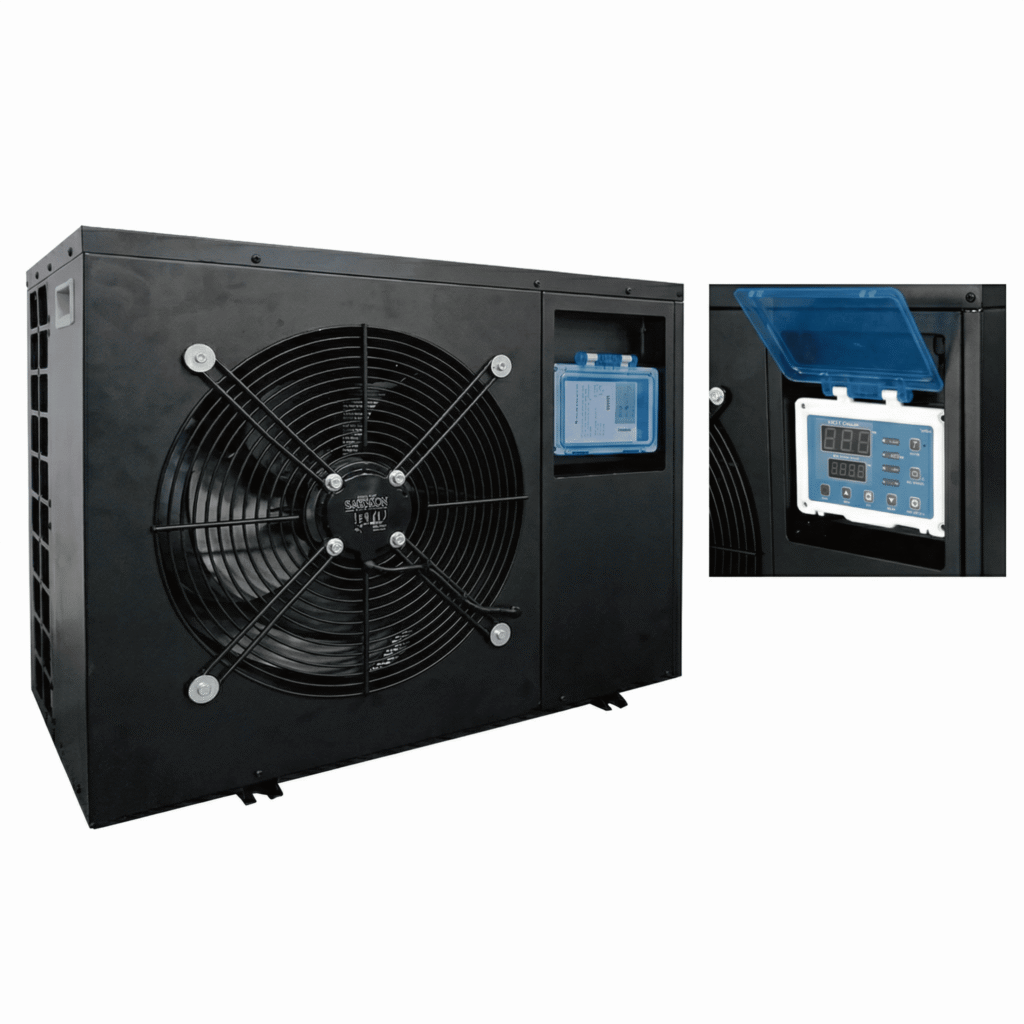
2. Confirm the Working Water Volume
Instead, size the system from the working water volume under the intended fill line and buyer-approved use condition, not the tub’s external volume or maximum geometric capacity. Interior dimensions, wall thickness, user displacement, inlet and outlet height, and required freeboard may affect the result.
Require the tub supplier to state the drawing revision, measurement basis, intended fill range, and calculated or measured working volume. Require the chiller supplier to identify the water-volume range covered by its performance information and all conditions attached to that information.
3. Verify Inflatable Ice Bath Chiller Compatibility Under Real Conditions
However, horsepower alone does not prove inflatable ice bath chiller compatibility. Cooling performance can change with starting water temperature, target temperature, ambient air, direct sunlight, wind, tub insulation, cover, hose length, circulation rate, heat from pumps, door openings, user turnover, and operating schedule.
- Working water volume and starting condition
- Requested temperature range and pull-down or hold objective
- Indoor or outdoor installation and expected ambient range
- Tub wall, floor, cover, openings, and insulation configuration
- Expected operating hours, recovery between uses, and user turnover
- Hose routing, exposed length, insulation, and elevation differences
- Pump, filtration, treatment, and other equipment in the loop
Therefore, ask the chiller provider to confirm the proposed configuration in writing. Do not copy a cooling time, minimum temperature, or capacity claim from another tub or installation.
4. Build an Inflatable Ice Bath Chiller Compatibility Interface Schedule
In practice, “standard connection” is not a complete purchasing specification. Create one interface schedule covering every point between the tub and circulation equipment.
| Interface field | What the buyer should record |
|---|---|
| Function | Tub draw, tub return, drain, overflow, service, or another defined role |
| Location | Drawing reference, height, orientation, spacing, and operating clearance |
| Connection | Thread or fitting standard, nominal size, gender, sealing method, and material |
| Mating part | Hose, adapter, valve, cap, plug, gasket, clamp, or quick connector reference |
| Responsibility | Tub supplier, chiller supplier, installer, buyer, or another approved party |
| Evidence | Drawing, photo, sample, dimensional check, leak check, or complete-system trial |

Photographs help identify the concept, but the approved drawing and component references should control the order.
5. Check Inflatable Ice Bath Chiller Compatibility Through the Flow Path
However, the words “inlet” and “outlet” can reflect the perspective of the tub or the chiller. Avoid connecting labels to labels without a system diagram. Record the direction of water at every component and use one agreed flow arrow through the complete loop.
The chiller manufacturer must define its required inlet, outlet, priming, water-level, and flow conditions. The tub supplier must define which port is intended to draw water and which returns it. The complete-system reviewer should confirm that the proposed routing does not create trapped air, restricted flow, unsupported hose loads, or inaccessible service points.

6. Define Hoses, Adapters, Seals, and Isolation Components
In addition, a system can fail at the small parts between the two main products. List every hose, adapter, gasket, O-ring, clamp, shutoff valve, cap, plug, and quick connector by reference and quantity.
- Internal and external diameters where relevant
- Thread or connector standard and mating orientation
- Material and intended water and temperature conditions
- Hose length, bend radius, routing, support, and insulation
- Seal type, installation direction, spare quantity, and replacement reference
- Isolation method for servicing or disconnecting the chiller
- Tool, tightening, sealing-tape, or installation requirements defined by the component provider
Do not assume that an adapter makes every combination suitable. The component providers and qualified installer must confirm sealing, structural support, flow, and service access.
7. Separate Pump, Filter, and Water-Treatment Responsibilities
Meanwhile, some chillers include circulation and filtration components, while others require external equipment. The compatibility record should state exactly what is built in, shipped separately, optional, provided by the tub supplier, or supplied by another party.
- Required and available flow conditions
- Pump location, priming method, and dry-run protection
- Filter type, direction, access, cartridge reference, and replacement interval defined by its provider
- Strainer, debris protection, and cleaning access
- Water-treatment equipment and material compatibility
- Drainage, flushing, winterization, storage, and restart responsibilities
Sanitation and chemical decisions should not be inferred from the inflatable tub alone. Obtain instructions from the relevant equipment and treatment providers and review them for the intended commercial setting.
8. Protect Inflatable Ice Bath Chiller Compatibility at the Tub Interfaces
Furthermore, inflatable ice bath chiller compatibility depends on how fittings are integrated into the tub. Review reinforcement, patch geometry, access, interference with walls or floors, hose loads, and the effect of inflation and water fill on the connection.

The final specification should identify the tub body construction, port assembly, reinforcement, component reference, and inspection method. Any change to the fitting or surrounding structure should trigger compatibility review.
9. Review Cover, Insulation, and Condensation Management
Likewise, a cover and insulated tub may reduce unwanted heat gain, but a general “insulated” claim does not predict system performance. Record the exact wall, floor, cover, openings, hose insulation, and installation conditions used for any comparison.
Also review condensation paths around the tub, hoses, fittings, and chiller. The buyer and qualified installer should address floor protection, slip risk, drainage, ventilation, separation from electrical equipment, and access for inspection and cleaning.
10. Validate Inflatable Ice Bath Chiller Compatibility as a Complete System
Therefore, do not approve the tub and chiller separately when they will be marketed or installed as one system. Assemble the exact proposed tub, fittings, hoses, adapters, seals, pump, filter, treatment components, cover, and chiller.
- Verify component identity against the bill of materials
- Confirm fit, orientation, access, support, and hose routing
- Check the flow diagram and equipment-provider setup requirements
- Inspect for leaks under agreed product-specific conditions
- Observe priming, circulation, alarms, restart, service, and drainage workflow
- Record test conditions, water volume, ambient conditions, duration, results, and exceptions
- Review instructions, warnings, labels, packing, and replacement-part references
- Close deviations and approve one identified reference configuration
Use the inflatable product factory audit checklist to verify how the approved tub configuration, purchased fittings, inspection records, changes, and production release are controlled.
11. Put Compatibility Requirements Into the RFQ and Order File
Finally, the private-label inflatable ice bath RFQ should include the chiller interface schedule, complete-system responsibility matrix, required drawings, component list, sample plan, evidence, packaging, quantity, destination, and approval sequence.
After sample approval, transfer the critical fields into an inflatable product quality agreement. Require written approval before changes to the tub construction, fittings, adapters, hoses, seals, pump, filter, cover, packaging, instructions, or nominated chiller.
| Approval document | Minimum compatibility content |
|---|---|
| System brief | Use setting, working volume, installation, operating workflow, destination, and responsibility owners |
| Interface schedule | Port function, drawing position, fitting, seal, mating part, hose, flow direction, and owner |
| Bill of materials | Exact tub, chiller, pump, filter, adapters, hoses, seals, accessories, and replacement references |
| Validation record | Configuration, conditions, method, results, exceptions, corrections, and approvers |
| Pack-out master | Components, quantities, labels, instructions, protection, carton identity, and packed data |
| Change control | Notification, impact review, revised documents, validation, and written approval |
Use the inflatable product packing checklist so that required adapters, seals, caps, hoses, instructions, and service parts are not omitted from the saleable unit.
Frequently Asked Questions
Does the same fitting size guarantee inflatable ice bath chiller compatibility?
No. The connection standard, gender, sealing method, material, orientation, flow requirement, hose, adapter, port reinforcement, and service access must also match.
Can a chiller be selected using the tub’s advertised capacity?
Use the intended working water volume and real installation conditions. Ask the chiller provider to confirm the configuration instead of relying on a maximum geometric capacity.
Who should supply the adapters and hoses?
The project can assign either supplier or another approved party, but the interface schedule must identify the owner, exact parts, quantities, validation, instructions, and replacement references.
Should buyers test the tub and chiller together before production?
Yes when they will be sold or installed as a system. The complete proposed configuration should be checked under buyer-approved, product-specific conditions before production release.
Request an Ice Bath Compatibility Review
Before requesting a quotation, assemble the tub drawing, working water volume, proposed chiller data, interface schedule, hoses and adapters, pump and filter scope, installation conditions, destination, and validation requirements.
ALS Leisure can review these inputs against the private-label inflatable ice bath range and identify missing compatibility decisions before sampling. Send the tub and chiller specifications to ALS Leisure to begin a structured design review.
